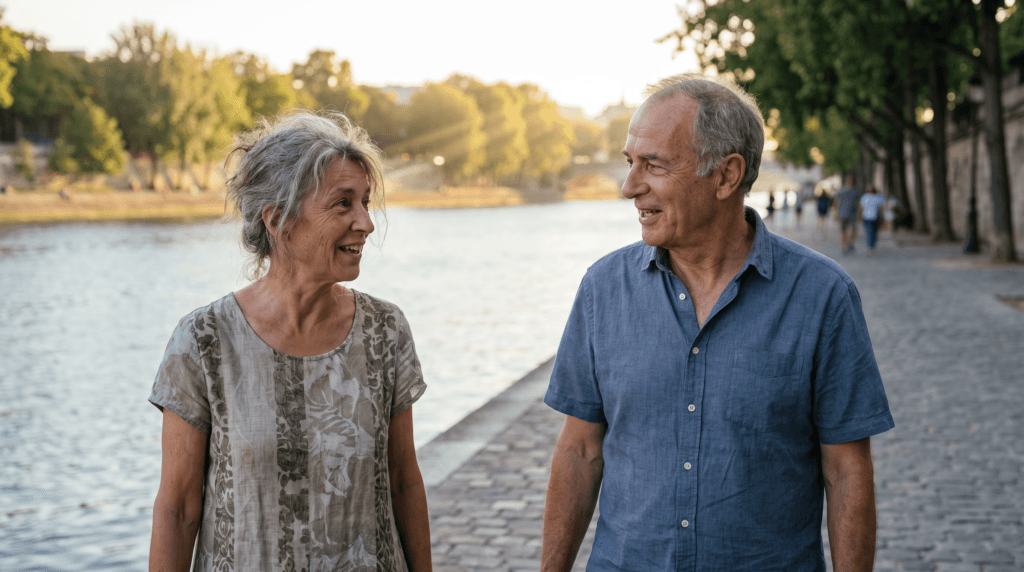
It’s half past seven in the evening, and it’s still bright. Light lies on the water, the air is warm enough for a T-shirt, and no one is looking at the clock because no one feels the day is already over.
That’s exactly what makes summer perhaps the easiest season for a first meeting. Not because an afternoon coffee or a glass of wine on a terrace would be bad. But because a first date often works best when the season helps a little: with light, with movement, and with an ending that comes naturally.
This article is the first part of our new series Seasonal Dates. Autumn, winter, and spring will follow in the coming weeks. If you prefer to search by location rather than season, you’ll find ideas in our city series for Basel, Zurich, Bern, Lausanne, Geneva, Lucerne, Winterthur, Lugano, and St. Gallen.
We’ll show you five ideas that deliberately differ from one another: one in motion, one quiet with a view, one covered for hot days, one culinary, and one that only works in summer. All five are accessible by public transport, require no equipment, and can be ended at any time.
What Summer in Switzerland Makes Easier for a Date
The biggest advantage is mundane and yet rarely used: It stays light for a long time. A meeting at 6 PM in summer is not yet an evening appointment. It’s a meeting in daylight that can last one hour or three, without anyone having to decide beforehand what it actually is. This openness takes a lot of pressure off both sides.
In addition, almost everything can take place outdoors. Outdoors, you sit face-to-face less often. You walk side by side, look in the same direction, and a pause in conversation doesn’t feel like a gap but like a pause. Those who haven’t been on a first date in a while often underestimate how much this direction of gaze matters.
You should be honest about three points. First, the heat: On days over 30 degrees, a walk at 3 PM is not a good idea, no matter how beautiful the route is. Second, vacation time: Between mid-July and mid-August, scheduling is more difficult, and popular places are crowded. Third, expectations: Summer is loaded with images of perfect evenings. A first meeting doesn’t have to match any of them.
One more word about the classic. Grilling in the garden is a nice thought, but unsuitable for a first meeting: it’s private, it takes time, and it’s difficult to end without someone having to explain something. Save that for the third or fourth time.
Waterfront Path Instead of Terrace Table
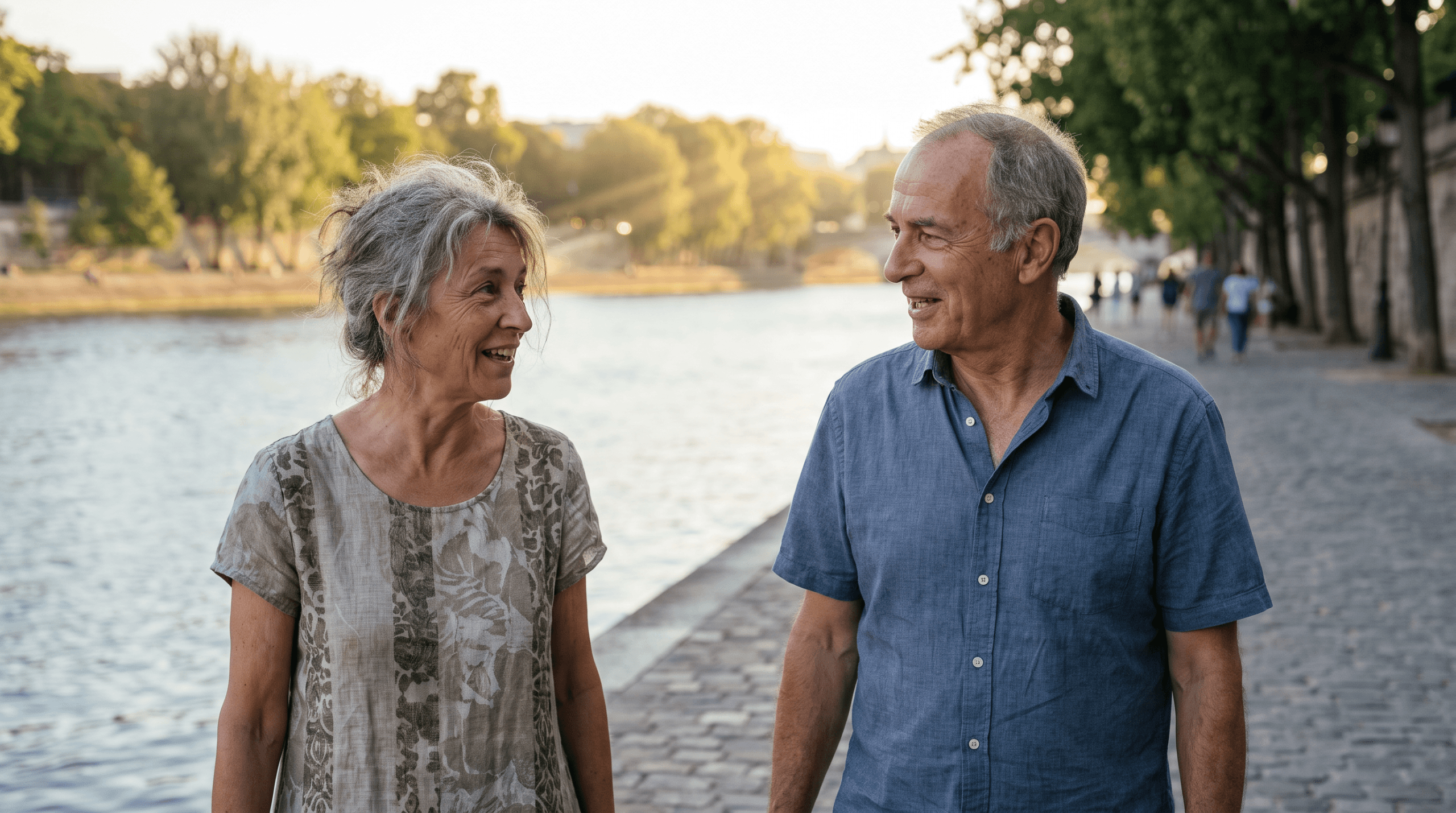
Waterfront paths are lively on summer evenings but never crowded—ideal for a first meeting without a fixed seat.
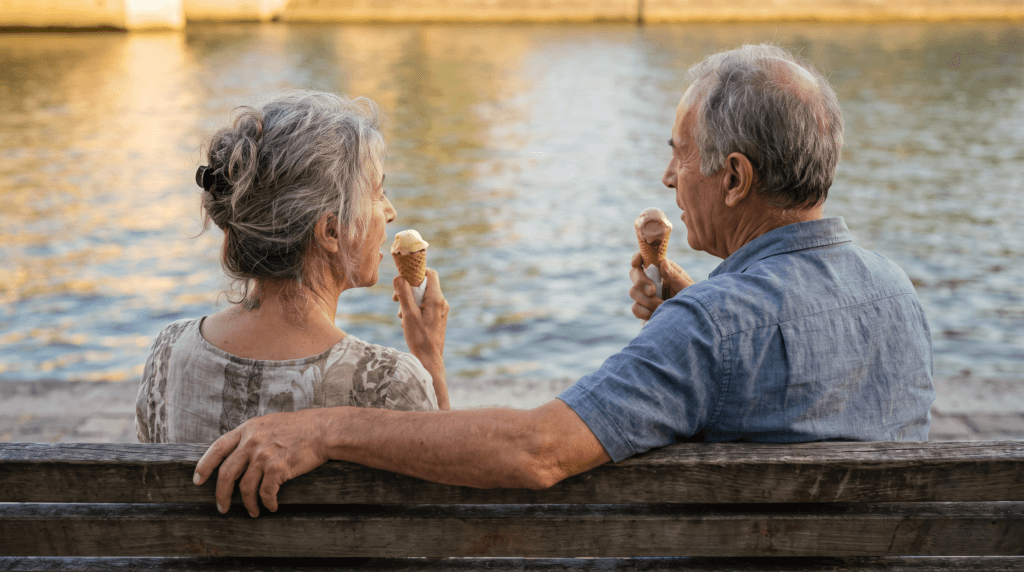
Switzerland has kilometers of paths along its rivers and lakes that are flat, lit, and usually well frequented. That’s precisely the quality: there’s always something going on without you being in the middle of it. You set off, buy an ice cream along the way, sit on a bench if you like, and keep walking if you like.
The advantage over a terrace table is mobility. At a table, it’s decided after ten minutes whether the conversation carries, and if it stalls, you’re stuck. On a waterfront path, there’s something new to see every few minutes, and you both determine the pace together without having to talk about it.
How to make it relaxed:
- Choose meeting point carefully: A fountain, a bridge, or a kiosk is better than “somewhere along the waterfront.”
- Consider direction beforehand: Knowing where the path leads means you don’t have to constantly decide.
- Ice cream as a natural break: It gives the walk a rhythm and gives your hands something to do.
- State a time window: “I have about an hour and a half” takes away the question of when to end for both of you.
For example: the Rhine waterfront path in Basel, the Quai in Ouchy near Lausanne, or the Lungolago in Lugano.
Mini conversation starters:
- “Did you grow up here or did you move here?”
- “What do you like to do most on a free summer evening?”
- “Is there a place in Switzerland you keep returning to?”
Plan for 60 to 90 minutes. That’s enough for a good conversation and short enough that both leave with the feeling it could have continued.
Local Mountain Instead of Mountain Tour
Almost every larger Swiss city has a local mountain with a railway—the ascent takes minutes, not hours.
You don’t need a hike for a view in Switzerland. Almost every larger city has a local mountain accessible by railway: ten to twenty minutes’ ride, a restaurant at the top, a few benches, and a view that carries any conversation. Only one thing is important: Check beforehand when the last train goes down. This time is your natural ending, and it spares you the question of who ends the evening.
Views make conversations easier because they always provide a topic. You show each other where you live, where you work, where you once lived. From such pointing conversations, the more personal ones emerge surprisingly quickly.
Why this works so well:
- No athletic demands: The railway handles the elevation gain; everyday shoes are sufficient.
- Clear framework: Go up, stay at the top, go down—the sequence is set.
- Always a topic: The view provides conversation material when there isn’t any.
- Cooler than below: On hot days, it’s often a few degrees less at the top.
For example: the Gurten near Bern, Monte Brè near Lugano, or Chaumont above Neuchâtel.
Mini conversation starters:
- “Where exactly do you live—can you see it from here?”
- “Did you used to spend a lot of time in the mountains?”
- “What’s the most beautiful view you remember?”
Allow 45 to 60 minutes at the top, plus travel time. Take a thin long layer with you; once the sun is gone, it gets cool quickly on a local mountain.
Museum Instead of Midday Heat
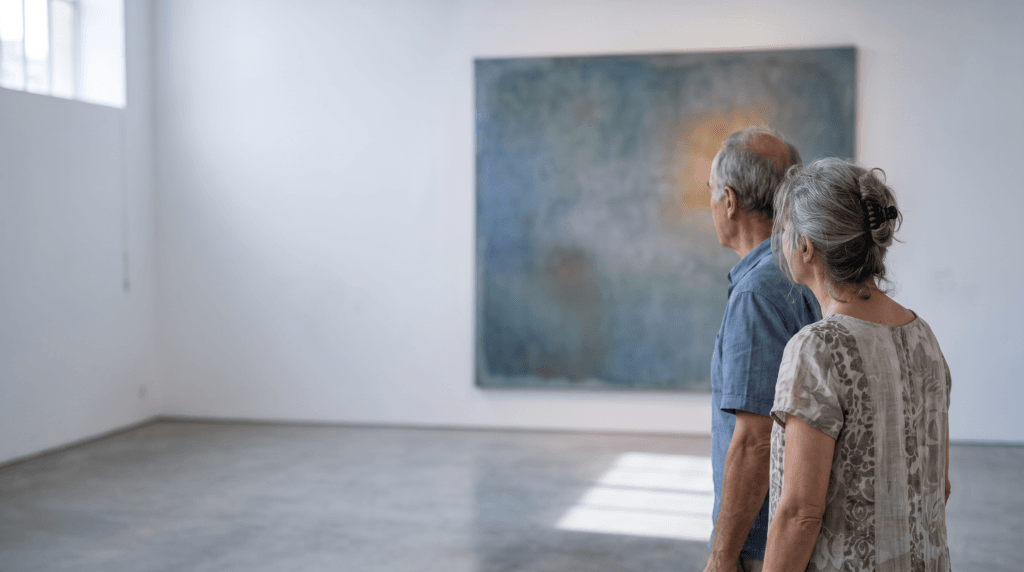
Museums are the most pleasant rooms in the city on hot days—and an exhibition tour gives the conversation structure on its own.
On a day with 32 degrees, a museum is not a fallback solution but the most pleasant place in the city: cool, quiet, shaded. There’s also an advantage that has little to do with the weather. In an exhibition, you don’t have to talk continuously. You go from room to room, stop, move on, and the silence in between is part of it.
Choose a manageable exhibition instead of a large house with five floors. One hour of focused viewing is pleasant; three hours is an achievement. And plan the café afterward right away: that’s where what you’ve seen gets sorted out, and usually this conversation is the best of the afternoon.
How to make it relaxed:
- Coordinate briefly beforehand: An exhibition that interests both is better than the most famous one.
- Check opening hours: Many institutions are closed one weekday; some have a late evening.
- Don’t try to see everything: Two or three rooms in peace are worth more than the entire tour.
- Plan café afterward: It extends the meeting without anyone having to ask.
For example: the Kunstmuseum Basel, Photo Elysée in Lausanne, or the MASI in Lugano.
Mini conversation starters:
- “Which painting would you take home?”
- “Do you usually go to museums or concerts?”
- “What interested you as a child—has that stayed with you?”
Plan for 60 to 90 minutes, not counting the café.
Weekly Market Instead of Menu Card
A market on Saturday morning offers movement, color, and constant new occasions to talk.
A restaurant visit on the first meeting means: two hours face-to-face, a bill, and no possibility to leave earlier. A weekly market on Saturday morning is the opposite. There’s movement, colors, smells, and constantly something to talk about without it seeming forced.
The nice part comes afterward. If you buy bread, cheese, tomatoes, and berries along the way, you have a picnic together that no one had to prepare. You find a bench or a meadow, and the shopping becomes a shared meal that you both put together. That’s a different feeling than a menu card.
Why this works so well:
- Shared activity: You decide together instead of questioning each other.
- Small amounts: Who pays what is not a question at five francs.
- Season as a topic: In July and August, there’s something on every table that isn’t there otherwise.
- Pleasant in the morning: Before the midday heat and with clear light.
For example: the market on Basel’s Marktplatz, the Marché de Plainpalais in Geneva, or the Saturday market in Bellinzona. A variant for the afternoon is a farm with self-picking—picking berries is movement, conversation, and result in one.
Mini conversation starters:
- “Do you like to cook, or is it more of a chore?”
- “What’s typically summer for you—a meal, a smell, something?”
- “Do you go to the market regularly or more randomly?”
Allow 60 to 90 minutes including picnic. Take some cash with you; not all stands accept cards.
Evening Boat Trip Instead of Bar Stool
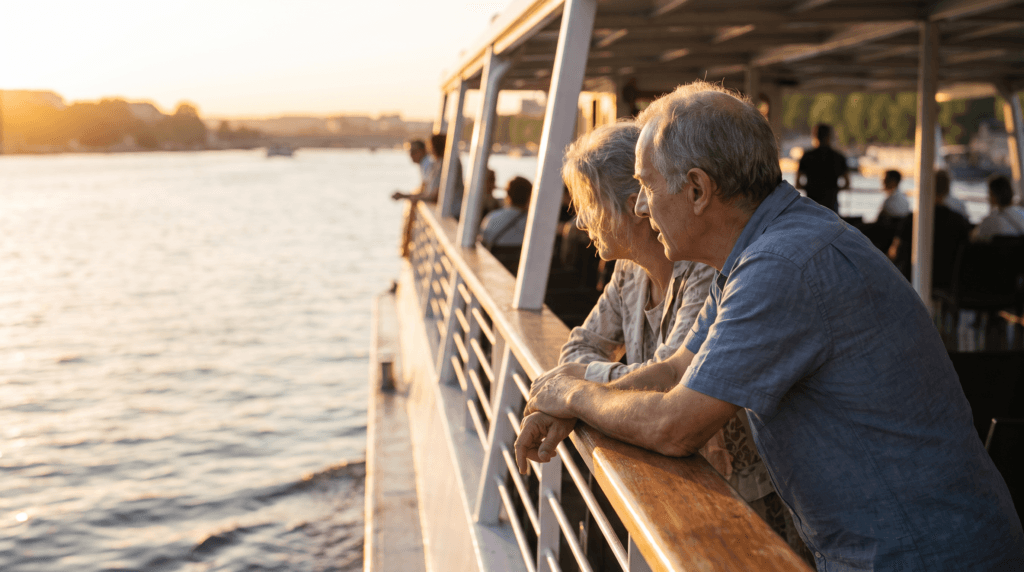
An evening cruise lasts as long as it lasts—the timetable takes care of the time planning.
This is the idea that only exists in summer. On almost all larger Swiss lakes, scheduled boats run until evening between May and September, many as round trips. You board, the boat departs, and for the next hour the question “What do we do now?” is answered.
The real appeal lies in the framework. A round trip has a beginning and an end, both are in the timetable. No one has to decide when it’s enough, and no one has to think up a reason to leave. In between is an hour when you stand side by side at the railing, occasionally say something, and watch the water. Check the conditions with Half-Fare or GA—on many lakes, scheduled boats are included in the General Season Ticket or significantly discounted.
How to make it relaxed:
- Round trip instead of route: You arrive where you boarded—no return journey to organize.
- Check timetable beforehand: Evening services run less frequently than daytime services.
- Stay outside: On deck it’s more pleasant and louder, which takes pressure off conversation.
- Be there early enough: In good weather, evening services are well attended.
For example: an evening cruise on Lake Lucerne from Lucerne, on Lake Geneva from Lausanne-Ouchy, or on Lake Lugano. If you prefer to stay on land: An open-air cinema serves the same purpose—a fixed beginning, a fixed end, and afterward a topic to talk about.
Mini conversation starters:
- “Are you more of a water or mountain person?”
- “When were you last on a boat?”
- “What would you do if you had a summer off?”
A small round trip usually lasts one to one and a half hours. That’s just right for a first meeting.
If the Weather Doesn’t Cooperate
In summer, two cases are likely: a thunderstorm in the late afternoon or a day that’s simply too hot. Both can be handled with one sentence if you already have the backup plan in mind.
- Waterfront path: a covered market hall or a café with a view of the water.
- Local mountain: postpone. A view without visibility isn’t worth it, and that’s not a bad sign either, but a good reason for a second meeting.
- Museum: works in any weather—that’s why it’s on this list.
- Weekly market: most larger markets take place even in rain; the picnic moves under a roof.
- Evening boat trip: Scheduled boats run normally in rain, but on deck it gets uncomfortable. Better to reschedule with a thunderstorm warning.
Those who reschedule at short notice don’t seem unreliable but attentive. A brief “With that thunderstorm, let’s postpone the mountain—shall we go to the museum instead?” is perfectly sufficient.
What You Should Have With You in Summer
- Sun protection and water—cap or hat, sunscreen, and a filled bottle
- A thin long layer—by the water and on local mountains it gets cool quickly in the evening
- Comfortable shoes—everything on this list involves walking
- Some cash—for market stands, kiosks, and ice cream
- A charged phone—for timetables, weather forecasts, and your own safety
Safety First
Even in the finest weather, the same principles apply as for any first meeting: Meet in a public, busy place, travel there and back independently, and tell a trusted person where you are and approximately when you’ll be back. You don’t have to explain to anyone why you’re doing this.
Two summer-specific points are added. Waterfront paths and viewpoints can be significantly more deserted after dark than thought the evening before—stay on lit, busy sections. And alcohol works faster in heat: a glass of wine on a terrace on a 32-degree day is something different than in November.
We’ve described this in more detail in our guide to safe first meetings.
Conclusion: Summer Takes the Pressure Off
A first meeting in summer doesn’t need a special idea. It needs light, movement, and an ending that comes naturally—and the season provides all three for free.
Whether you walk along a river, take a railway up a local mountain, stand in a cool exhibition, walk through a market together, or take a round trip on a lake: what matters is not how special the idea is. What matters is that you both know afterward whether you want to see each other again.
A good first date doesn’t arise from effort. A good first date arises from a framework that gives both people space.
👉 Start with DuoLivo now—and use the summer for a first meeting: Register for free
Frequently Asked Questions
Between one and two hours is a good framework. Because it stays light for a long time, summer dates easily extend themselves—that’s nice if both want it, and uncomfortable if not. Mention casually at the beginning how much time you have. If it goes well, you can always extend.
Most ideas on this list are between 10 and 50 francs per person. A waterfront walk with ice cream costs almost nothing, a museum admission usually 15 to 25 francs, a mountain railway or a boat cruise more depending on the route. With Half-Fare or GA, railways and scheduled boats are often significantly cheaper or included.
Write briefly, suggest an alternative, done. Summer thunderstorms are normal and not a bad omen. Those who have a covered alternative ready seem prepared rather than awkward—and if both prefer to postpone the appointment, that’s also a perfectly normal beginning.
Not really for a first meeting. Swimwear presupposes a familiarity that usually isn’t there yet the first time, and those who feel uncomfortable have their mind elsewhere. A waterfront path with feet in the water offers the same summer atmosphere without this hurdle. For a later meeting, that’s different.
Early evening between 5 and 7 PM. The greatest heat is over, the light is pleasant, and it stays light for hours. For markets and exhibitions, the morning is the better choice—quieter and cooler than the afternoon.