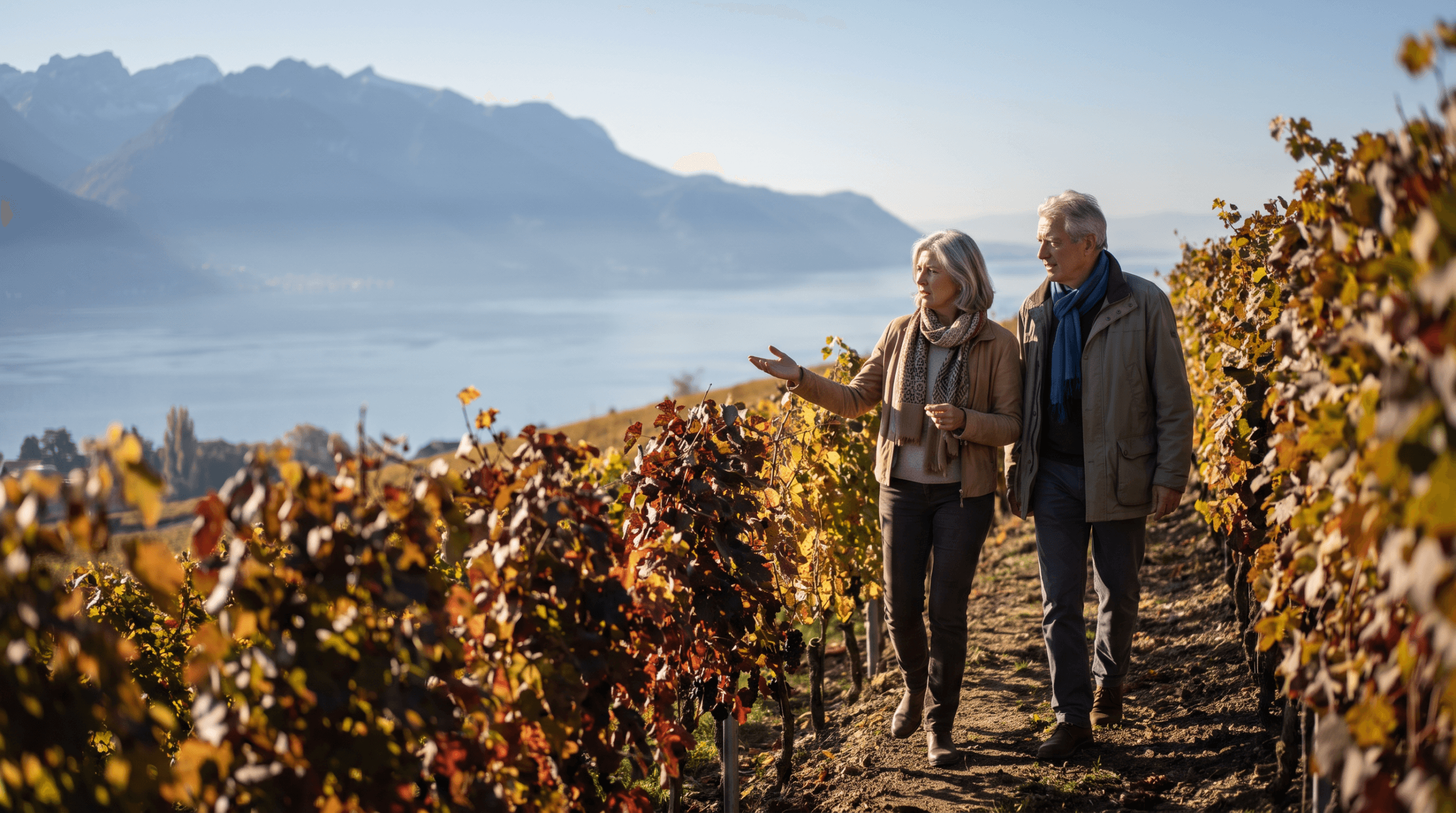
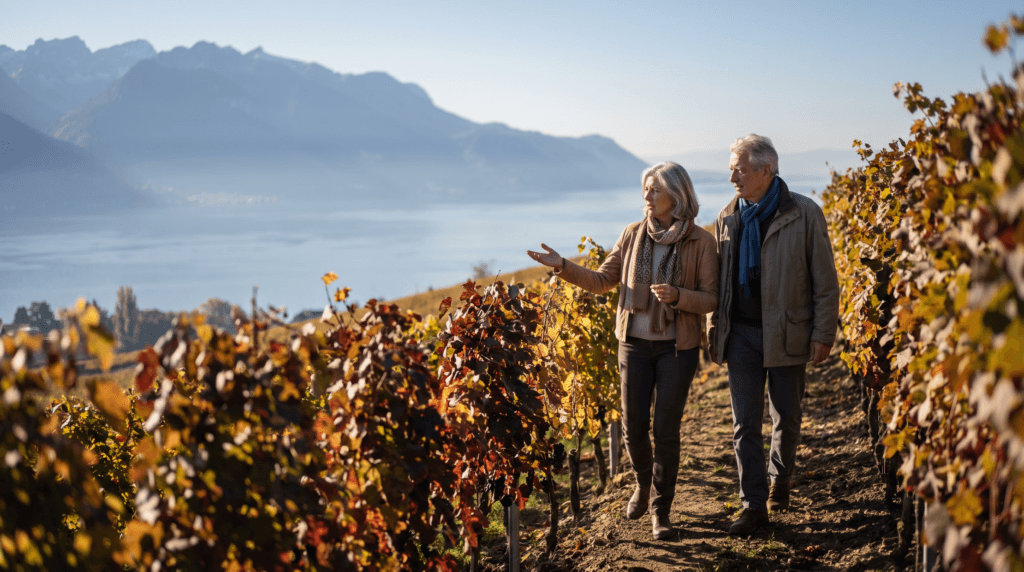
It rained overnight, and in the morning the air is so clear you can see mountains that were lost in summer haze for months. The light is low, the vines have turned, and it is just cool enough that walking feels better than sitting.
Autumn has a reputation as a melancholy season. For a first meeting, it is one of the best times of the year. Not because a walk through fallen leaves would be a bad idea. But because autumn forces you to think a little ahead—and that small amount of planning is exactly what comes across to the other person: as consideration, not as effort.
This article is the second part of our Seasonal Dates series. Part 1 with five ideas for summer is already out; winter and spring will follow in the coming weeks. If you prefer to search by location rather than season, you will find ideas in our city series for Basel, Zurich, Bern, Lausanne, Geneva, Lucerne, Winterthur, Lugano and St. Gallen.
We will show you five ideas that are deliberately different: one active, one calm with a view, one covered for grey days, one culinary, and one that only exists in autumn. All five are reachable by public transport, require no equipment, and can be ended at any time.
What autumn in Switzerland makes easier for a date
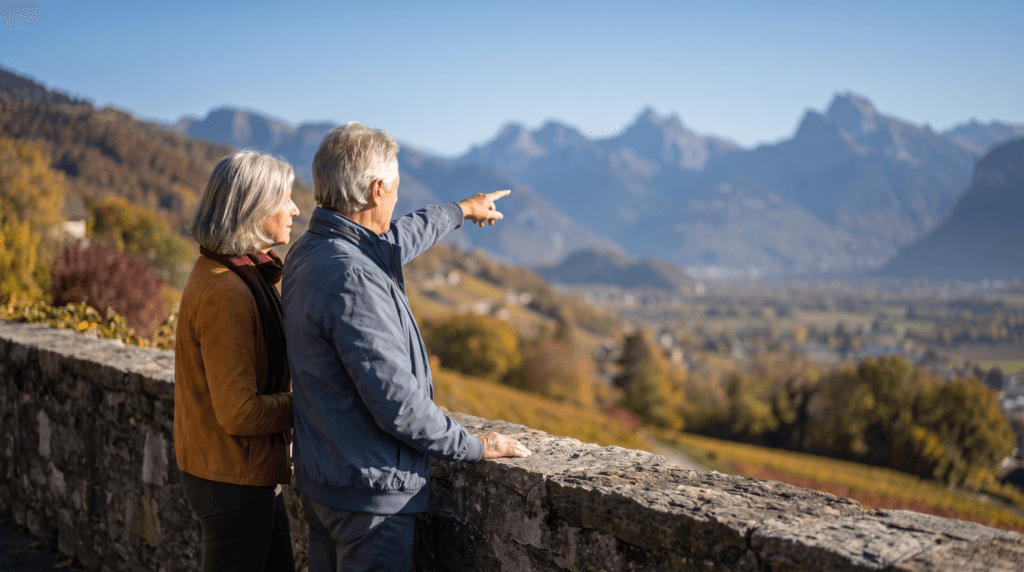
Autumn offers something summer does not: clear visibility. After the first cool nights, the summer haze disappears and long-distance views become as good as they ever are. If you want to use a view as a setting for conversation, this is when you have the best odds.
On top of that, places get quieter. Lakeside paths, mountain railways and excursion destinations are noticeably calmer from mid-September than in July. You do not have to squeeze through crowds, you can find a spot, and you can talk without raising your voice. For a first meeting, that is worth more than sunshine.
And the days get shorter again, which oddly helps. A meeting at 3 PM is an afternoon with a clear end in autumn, not half an evening that quietly stretches on. If you are unsure how much time you want to invest, autumn makes it easier to find a manageable framework.
There are three points where you should be honest. First, the fog: In the Swiss Plateau it can linger for weeks and it weighs on your mood. Second, the sudden changes: An autumn day can be golden in the morning and wet by afternoon. Third, the darkness: At the end of October the clocks change, and after that daylight is gone by 5 PM. If you plan for it, it will not catch you off guard.
All three points point to the same thing: a quick look at the forecast the evening before, and a covered alternative in the back of your mind. That is all the planning you need.
Vineyard instead of forest path
In vineyards, the grapes are harvested between September and October—the paths are public and the activity is visible.
A forest path in autumn is beautiful, but it looks the same all the way. A vineyard does not. The rows change colour, the view stretches far, and between mid-September and late October the harvest is on: tractors pass by, people stand between the rows, and it smells of grape must. You are walking through a landscape where something is happening right now.
The paths through the vines are public almost everywhere, well signposted, and rarely steep. The best part is the structure: there is a start at the bottom, a destination at the top or at the other end, and usually a restaurant or a wine tavern along the way. You do not have to decide as you go what happens next—the route decides for you.
How to make it relaxed:
- Choose your direction thoughtfully: Starting uphill and finishing downhill is more pleasant than the other way around.
- Plan a stop: A glass of Sauser or a coffee on the way gives the walk a rhythm.
- Shoes with grip: Vineyard paths are slippery after rain, but trainers are usually still fine.
- Name a time window: “I have about two hours” removes the question of when it ends for both of you.
For example: Lavaux on Lake Geneva with the stations Grandvaux, Rivaz and Epesses; the Bündner Herrschaft around Maienfeld; or the Mendrisiotto in southern Ticino.
Mini conversation starters:
- “Do you like wine, or is it not really your thing?”
- “Have you ever been part of a grape harvest?”
- “What do you like about autumn—and what do you not like at all?”
Allow 90 to 120 minutes. Check the return journey in advance: small stations in wine-growing areas are not served every 15 minutes.
Above the fog instead of in the middle of it
Between October and December, the fog ceiling on the Swiss Plateau is often between 800 and 1,200 metres—above it, the sun is shining.
This is the loveliest quirk of Swiss autumn: on a grey November day on the Swiss Plateau, the sun is often only a few hundred metres higher. You get on a train down below, ride twenty minutes through dull grey, and suddenly it is bright, warm and quiet, with a white sea beneath you.
For a first meeting, this moment is hard to beat because it works without any effort. You do not have to say anything when you arrive at the top—the view does the work. And because you are both seeing the same thing for the first time that day, it creates a shared starting point that no conversation topic could manufacture.
Why this works so well:
- No climb required: Twenty minutes of travel replaces any hike; everyday shoes are enough.
- Check conditions beforehand: The fog ceiling is listed in any good forecast, and mountain railways show live webcams.
- Dress warmly: Above the fog it is sunny, but not mild.
- Note the last ride: In autumn many lines run their last service earlier in the evening—this is your natural end point.
For example: Rigi from Vitznau or Arth-Goldau, Weissenstein above Solothurn, or Monte Generoso in Ticino.
Mini conversation starters:
- “Are you more of a summer person or a winter person?”
- “When was the last time you had a moment where you just looked?”
- “What do you do when it is grey down below for weeks?”
Plan for 60 to 90 minutes up top, plus travel time. With a Halbtax or GA, many mountain railways are significantly cheaper.
A show instead of a TV evening
The season starts in September: theatres, concert halls and small stages fill their programmes.
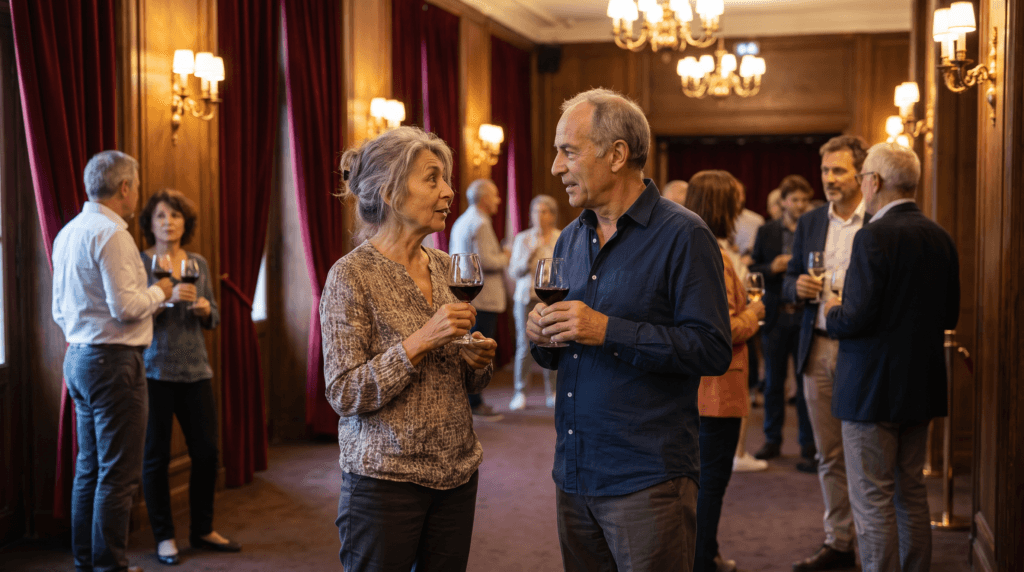
In September, the season starts across Switzerland. Theatres, concert halls and small stages launch new programmes, and the choice is larger than at almost any other time of year. An evening at a show is therefore the most reliable covered autumn idea—it works in any weather, because the weather does not matter.
The real advantage is how the evening is structured. Beforehand, you have twenty minutes in the foyer; afterwards, you have something to talk about. In between are 90 minutes when nobody has to talk. If you worry about awkward silences on a first meeting, this is the most comfortable setting imaginable: the pauses are built in.
Choose shorter rather than bigger. A 90-minute concert or a play on a small stage suits a first meeting better than an opera with two intervals and four hours’ running time.
How to make it relaxed:
- Choose together: Send two or three suggestions and let them decide, instead of surprising them with tickets.
- Check the length: Ninety minutes without an interval is ideal for a first time.
- Have a drink beforehand: Twenty minutes in the foyer replaces the first awkward quarter-hour.
- Do not plan anything fixed afterwards: If it goes well, the rest will take care of itself.
For example: Theater Basel, Théâtre de Vidy in Lausanne, or LAC in Lugano. Smaller stages and basement theatres are often the better choice: cheaper, closer to the action, and easier to talk about afterwards.
Mini conversation starters:
- “Do you go to the theatre regularly, or only rarely?”
- “What was the last thing that really impressed you?”
- “Would you have written the ending that way too?”
Plan the evening from around 7 PM, with a 20-minute buffer. If you are unsure: a Sunday morning matinee is the more relaxed version of the same format.
Roasted chestnuts instead of a reservation
From October, roasted-chestnut stands appear in almost every Swiss city—plus autumn fairs and chestnut festivals.
A restaurant on a first meeting means: two hours facing each other, a bill, and no easy way to leave early. An autumn market is the opposite. There are stalls, smells, movement—and you buy a bag of hot roasted chestnuts to share as you keep walking.
Culinarily, autumn is Switzerland’s richest season: chestnuts, plums, pumpkin, new wine, game. From October, autumn fairs and chestnut festivals are added—events that have taken place in many towns for centuries. You do not need a programme—you go, you walk around, and the programme emerges on its own.
Why this works so well:
- Doing something together: You stroll and look, instead of interviewing each other.
- Small amounts: A bag of roasted chestnuts settles the “who pays” question in five seconds.
- Warmth in your hand: A bag of roasted chestnuts is worth more on a cool day than it costs.
- Easy to end at any time: A market has no schedule you have to follow.
For example: the Basel Autumn Fair in late October; a Castagnata in Ticino, for instance in Ascona or Mendrisio; or the Zibelemärit in Bern on the fourth Monday in November—the last one starts at 4 AM, though, which is more of a date for advanced users.
Mini conversation starters:
- “Do you cook differently in autumn than in summer?”
- “Is there a food that immediately reminds you of earlier times?”
- “Did you go to markets like this as a child?”
Allow 60 to 90 minutes. Bring cash—many stalls do not accept cards.
A cattle drive down from the Alps instead of a Sunday outing
Depending on the region, cattle drives down from the Alps take place between mid-September and mid-October—the dates are set at short notice and depend on the weather.
This is the one idea that only exists in autumn. When the cattle come back down from the Alps into the valley, they are decorated, bells ring, it is loud, and whole villages line the roadside. A cattle drive down from the Alps is not an event invented for tourists, but a working day you are allowed to watch.
For a first meeting, an event like this is almost ideal—for an unromantic reason: It is too loud for a deep conversation. You stand side by side, point things out, laugh at a particularly quirky cow, and speak in short sentences. The pressure to keep a conversation going disappears completely—and afterwards, over a sausage or a coffee, talking becomes much easier.
How to make it relaxed:
- Check the date early: Dates are often only confirmed a few weeks in advance and depend on the weather.
- Arrive early: Trains and PostBuses are full on these days, and the best spots are taken early.
- Do not stay too long: One to two hours is enough; after that, the novelty wears off.
- Plan something afterwards: A coffee in the village turns the event into a conversation.
For example: the Désalpe in Charmey in the canton of Fribourg, the cattle drive down from the Alps in Urnäsch in Appenzell, or the Désalpe de Saint-Cergue in Vaud.
Mini conversation starters:
- “Do you have a connection to the countryside, or are you a pure city kid?”
- “What would you have done if you had not chosen your profession?”
- “Is there a Swiss tradition you genuinely like?”
Allow half a day, including travel there and back. That is more than the other ideas—so the cattle drive down from the Alps is better suited to a second or third meeting than the very first.
If the Weather Doesn’t Cooperate
In autumn, this is not the exception but the norm. A look at the forecast the evening before and an alternative in mind are enough to turn it into a relaxed afternoon instead of a failed one.
- Vineyard: Still lovely in light rain with a jacket; in persistent rain, move it to a wine shop or wine bar—same topic, under cover.
- Sea of fog: Check the fog ceiling and the mountain railway webcam beforehand. If the fog is higher than the summit, postpone. A view without visibility is not worth it.
- Show: works in any weather—that is why it is on this list.
- Autumn market: Most take place in any weather; the stalls have roofs. In storms they are cancelled—your municipality’s website will say so.
- Cattle drive down from the Alps: In bad weather it is postponed, sometimes by a day. Check the evening before.
If you reschedule at short notice, you do not seem unreliable—you seem attentive. A brief “The fog is too high today, it is not worth it—shall we do … instead?” is entirely sufficient. And a postponed date is not a failed date, but a good reason for a second attempt.
What you should bring in autumn
- A waterproof jacket—more important than an umbrella, because it keeps your hands free
- Shoes with grip—vineyard, forest and field paths are slippery after rain
- A warm layer—above the fog and after sunset it cools down quickly
- Some cash—for roasted-chestnut stands, markets and small local pubs
- A charged phone—for timetables, forecasts, webcams and your own safety
Safety First
Even on an outing that seems harmless, the same basic principles apply as for any first meeting: Meet in a public, busy place, travel there and back independently, and tell someone you trust where you are and roughly when you will be back. You do not have to explain to anyone why you do this.
Two autumn-specific points are added. It gets dark much earlier than it feels—by late afternoon from the end of October. Plan your way back so it does not go through unlit sections. And for mountain railways, note the last descent before you go up; in autumn, operations end earlier than in summer.
We’ve described this in more detail in our guide to safe first meetings.
Conclusion: Autumn rewards those who think a little ahead
A first meeting in autumn does not need better weather than the day provides. It needs a look at the forecast the evening before and an alternative in mind—and an uncertain season becomes one that has more to offer than summer: clear visibility, quieter paths, and events you do not get at any other time.
Whether you walk through a vineyard, ride up above the fog, watch something for an evening, stroll through a market together, or watch a cattle drive down from the Alps: what matters is not how special the idea is. What matters is that afterwards you both know whether you would like to see each other again.
A good first date doesn’t arise from effort. A good first date arises from a framework that gives both people space.
👉 Get started with DuoLivo now—and use autumn for a first meeting
Frequently Asked Questions
Between one and two hours is a good framework. Because it gets dark early, an afternoon meeting in autumn has a natural end that nobody has to say out loud. Mention casually at the start how much time you have. If it goes well, you can always extend it.
Most ideas on this list cost between CHF 10 and CHF 60 per person. A walk through the vineyards with a glass of Sauser costs little; a mountain railway, depending on the route, CHF 20 to CHF 50; and theatre or concert tickets on small stages often start at CHF 25. With a Halbtax or GA, railways are significantly cheaper, and many venues have discounted allocations.
Write briefly, suggest an alternative, done. In autumn, that is normal and not a bad sign. If you have a covered backup idea ready, you come across as prepared rather than fussy—and if you both prefer to postpone, that too is a completely normal start.
Two sources are enough. MeteoSwiss forecasts state the fog ceiling in metres above sea level; if it is below the altitude of your destination, the sun is shining there. And almost every mountain railway runs a live webcam showing the current view. A call to the valley station in the morning is the third—and most reliable—option.
Move the time earlier. A meeting at 2 or 3 PM still gives you two to three hours of daylight in autumn and then ends on its own. For later times, lit, busy places are better than paths through forest or fields—or simply choose one of the covered ideas from this list.