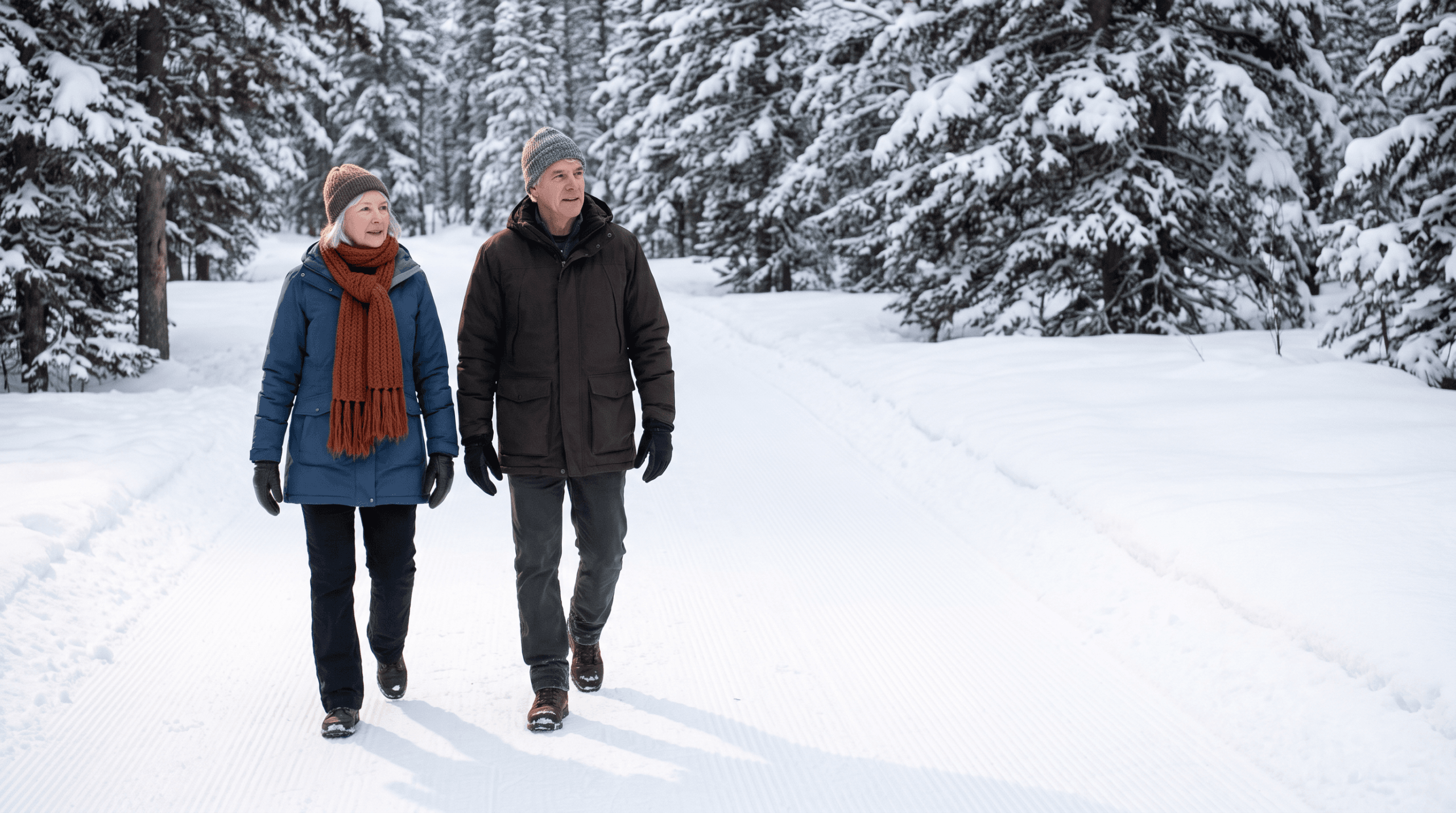
It’s two in the afternoon, the air is cold and dry, and the snow on the trees holds the light so firmly that the whole day feels brighter than it is. In three hours it will be dark. Until then, everything belongs to you.
Winter is considered the hardest season for a first meeting: too cold, too dark, too few options. That’s only true if you treat it like summer. Not because a dinner together would be a bad idea. But because a first date becomes easier when you’re not sitting face to face the entire time – and that’s exactly the real task in winter.
This article is the third part of our series Seasonal Dates. Already published are part 1 with ideas for summer and part 2 for autumn; spring will follow shortly. Those who prefer to search by location rather than season will find ideas in our city series for Basel, Zurich, Bern, Lausanne, Geneva, Lucerne, Winterthur, Lugano, and St. Gallen.
We present five ideas that are deliberately different from one another: one active, one calm with a view, one indoors for grey days, one culinary, and one that only exists in winter. None of them require winter sports skills. All five can be reached by public transport, require no equipment, and can be ended at any time.
What makes a date easier in Switzerland during winter
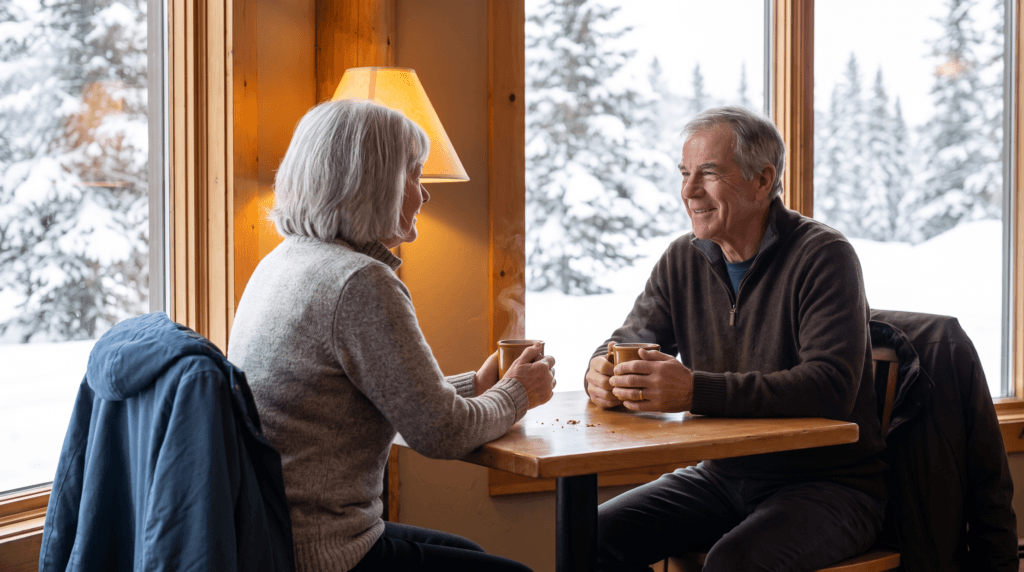
Winter has an advantage you only notice once you use it: warmth becomes an event. Every idea on this list consists of an outdoor part and an indoor part, and the transition between the two gives the meeting a structure all on its own. You go outside, you come back in, you warm your hands on a cup. That’s a rhythm you’d have to create artificially in summer.
Then there’s the light. Clear winter days are among the most beautiful of the year, because the sun sits low and the air is free of haze. It’s just that this light doesn’t last long – and that’s exactly an argument for meeting in the early afternoon rather than the evening. A date at 2 PM in January has two and a half hours of daylight, and when it gets dark, a natural end point is set that no one has to put into words.
There are three points worth being honest about. First, the cold: everything takes less time in winter than you plan for, and no one has a good conversation with cold feet. Second, December: between Advent events, family commitments, and year-end obligations, finding a date is difficult – January and February are the more relaxed months. Third, fog on the Swiss Plateau: it sometimes lingers for weeks, and you shouldn’t wait for it to clear.
A word on the classic: the Christmas market deliberately doesn’t appear on this list. It’s lovely, but loud, cramped, and crowded – you can barely hear the other person, you stand rather than walk, and conversation doesn’t flow. For a second or third meeting in December, it’s wonderful. For a first one, it’s the hardest place of the season.
Winter hiking trail instead of ski slope
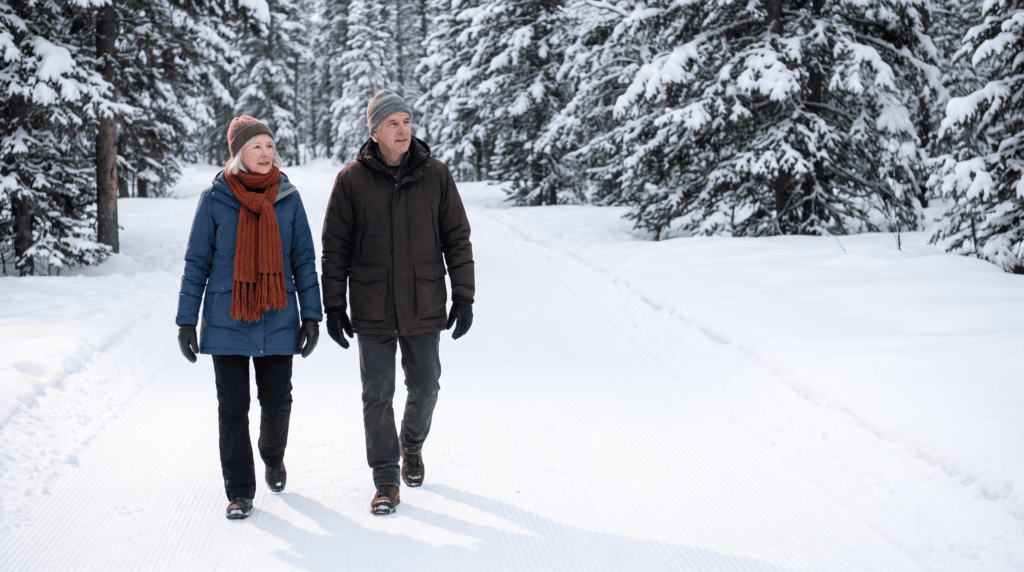
Winter hiking trails are groomed, marked, and mostly flat – no winter sports skills required.
Switzerland has several thousand kilometers of groomed winter hiking trails, and hardly anyone knows about them. These are rolled, marked paths, usually signposted in pink, running alongside the slopes or well away from them. You walk there in ordinary winter boots, with no equipment, no skill, and no day pass needed.
For a first meeting, this is ideal, because the trail takes care of everything else. There’s a route, a destination, and usually a mountain restaurant along the way. You walk side by side, the conversation moves at walking pace, and when it goes quiet, the silence outside in the snow feels pleasant rather than awkward. Choose a short route of under an hour – in winter you get tired faster, and noticeably colder, than you think.
How to make it relaxed:
- Plan short, not ambitious: Forty to sixty minutes of walking is plenty.
- Choose a warm destination: A sun terrace or mountain restaurant at the end of the route is half the success.
- Pay attention to footwear: Tread and warm socks matter more than brand or model.
- Note the last descent: It gives you a natural ending and saves you from having to decide who calls time on the afternoon.
For example: the car-free village of Braunwald in the canton of Glarus, Leysin in the Vaud Alps, or Cardada above Locarno.
Mini conversation starters:
- “Do you like winter, or are you counting the days until spring?”
- “Did you used to ski, or was that never your thing?”
- “What do you do on a Sunday when it’s snowing?”
Plan for 60 to 90 minutes on site, plus travel time. Sunglasses are a must: snow glare is stronger than on any summer day.
Panoramic train instead of summit climb
On the panoramic routes, you stay warm yet still have the full view – in any weather, without a single step in the snow.
For a view in winter, you don’t need to climb anywhere, or even get off the train. Switzerland has a network of railway lines that are more beautiful in the snow than in summer: viaducts, spiral tunnels, snow-covered valleys, all at a comfortable temperature inside the carriage. You sit side by side, looking in the same direction, while the scenery outside changes every few minutes.
This is the calmest setting this series has to offer. A timetable has a beginning and an end, both fixed, and no one has to decide when it’s time to stop. Those who get off can have a coffee and take the next train back; those who stay seated keep talking. Choose a section of the route rather than the whole line – a two-hour ride is an experience, six hours is a journey.
Why this works so well:
- Weather-independent: snowfall makes the ride more beautiful, not harder.
- Physically completely effortless: no walking in snow, no ice, no altitude gain.
- Seated side by side: you look outward together instead of facing each other across a table.
- Use your Half Fare Card or GA Travelcard: the regular fare applies on standard trains along the same routes – panoramic carriages often cost a surcharge, but it isn’t required.
For example: the Albula line between Chur and Filisur, the GoldenPass line from Montreux to Zweisimmen, or the Centovalli railway from Locarno toward Domodossola.
Mini conversation starters:
- “Do you enjoy train travel, or is it purely a means of getting from A to B for you?”
- “What’s the most beautiful route you’ve ever traveled?”
- “Where would you go if the train just kept going?”
Allow for two to three hours including the return trip. Sit on the valley side, and check beforehand whether the route is running without diversions that day.
Hands-on museum instead of art tour
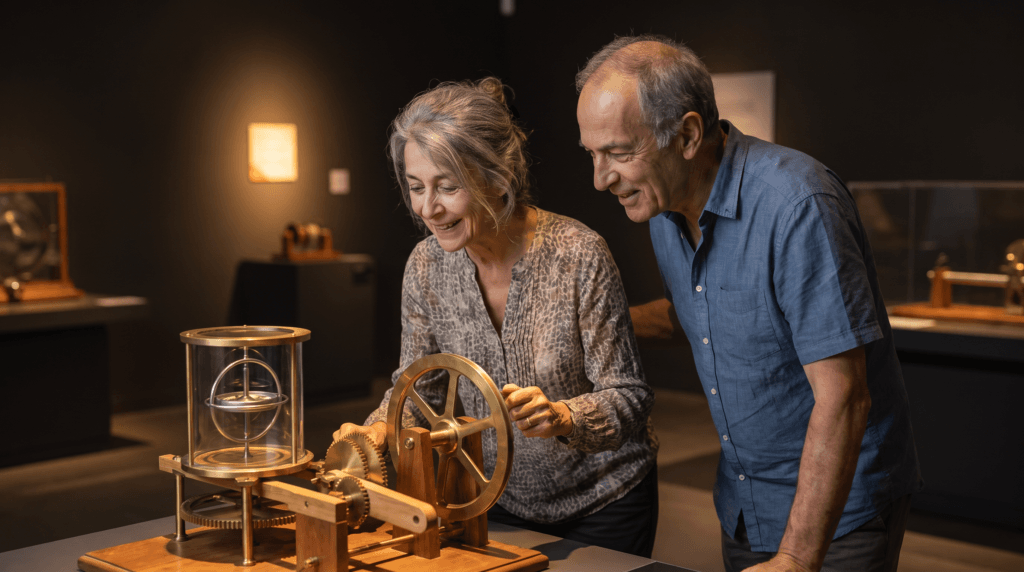
In hands-on museums, you talk about the exhibit rather than about yourself – which takes the stiffness out of any first meeting.
On a grey January day, a museum is the obvious answer. Yet a quiet walk through a painting collection isn’t comfortable for everyone on a first meeting: you whisper, you’re never quite sure how long to stand in front of a painting, and anyone who doesn’t know much about art quickly feels tested.
Hands-on museums solve this problem. You turn something, press a button, marvel together at the result, and laugh when something doesn’t work. You talk about the exhibit, not about yourself – and that’s exactly how closeness builds faster than through mutual questioning. A first meeting shouldn’t feel like a job interview, and here it guaranteed won’t.
How to make it relaxed:
- Two or three sections, not everything: these museums are large, and three hours is tiring.
- Prefer a weekday: on weekends and during school holidays, they’re full of families.
- No need to explain anything: there’s no prior knowledge required.
- Plan a café at the end: that’s where you process what you’ve seen.
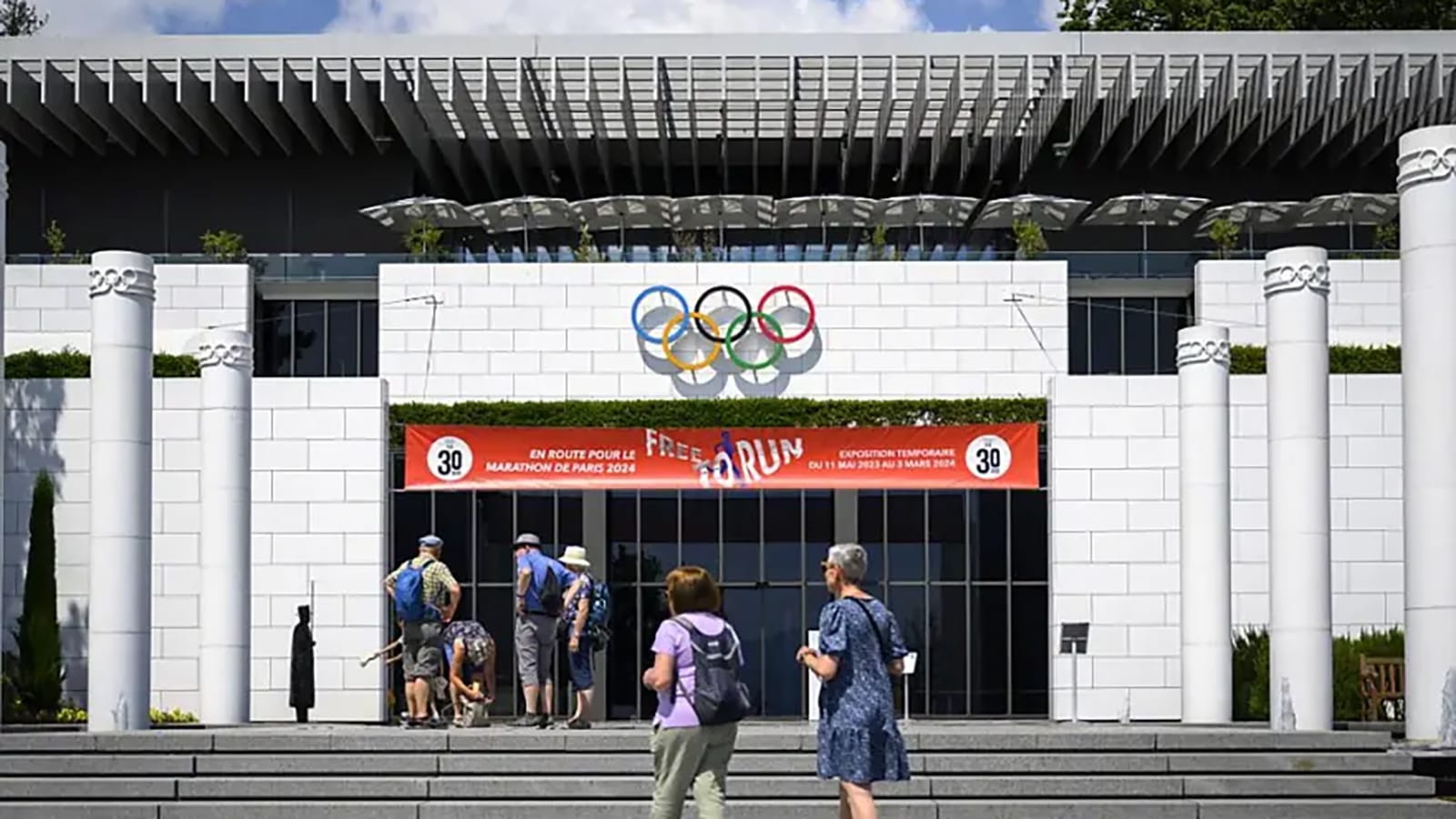
For example: the Technorama in Winterthur, the Swiss Museum of Transport in Lucerne, or the Olympic Museum in Lausanne.
Mini conversation starters:
- “Were you more the science type at school, or the opposite?”
- “Is there something you’ve always wanted to understand?”
- “What’s the last thing that really surprised you?”
Plan for 90 to 120 minutes, not counting the café.
A manufactory instead of a fondue parlor
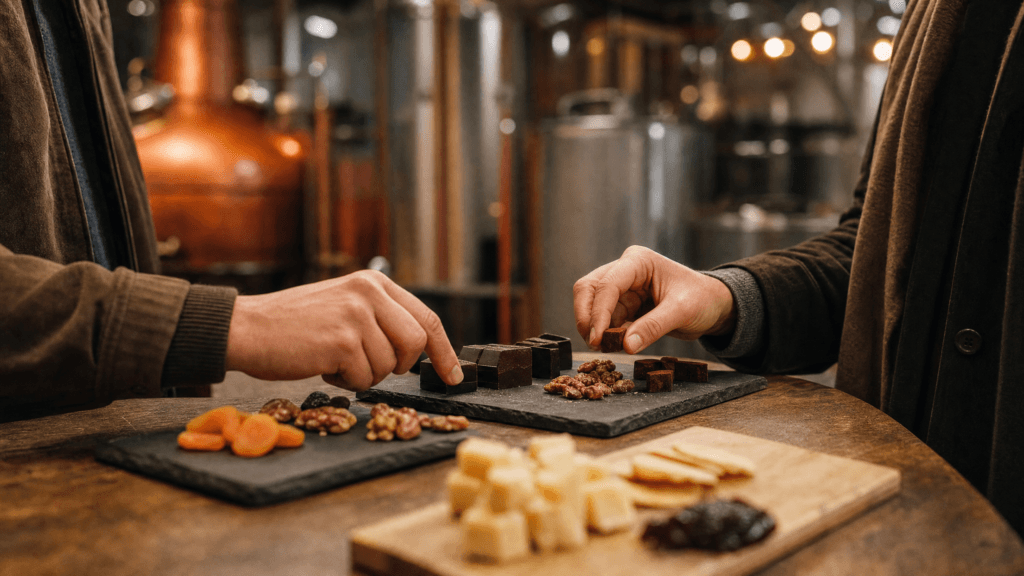
A guided tour and tasting give the meeting a clear structure – and afterward, you’ll have something to talk about.
Fondue is the standard winter suggestion, and it has a catch: you sit for two hours at a small table, facing each other, fork in hand, and if the conversation stalls, you watch each other struggle with it. For a first meeting, that’s a lot to ask.
A dairy or a chocolate manufactory offers the same theme with the opposite effect. There’s a guided tour with a set structure, there’s something to see, smell, and taste, and you’re moving while you do it. The framework is set, the conversation topics are right there on the table, and the tasting at the end is a natural transition to the relaxed part of the date – or to saying goodbye, whichever fits.
Why this works so well:
- Set structure: beginning, tour, tasting, end – nothing has to be negotiated.
- Doing something together: you taste and compare instead of questioning each other.
- Indoors and warm: weather doesn’t matter.
- Reserve in advance: tours run at fixed times and are often fully booked on weekends.
For example: the Lindt Home of Chocolate in Kilchberg near Zurich, Maison Cailler in Broc in the canton of Fribourg, or Alprose in Caslano near Lugano. Those who prefer something savory will find the same idea with cheese at dairies such as the one in Stein in the Appenzell region.
Mini conversation starters:
- “Are you more sweet or savory?”
- “Is there something you treat yourself to regularly?”
- “Do you cook or bake yourself – and honestly, how good are you at it?”
Allow for 90 minutes for the tour and tasting. If you’re still in the mood for fondue afterward, at least you’ll know the conversation can carry it.
Ice rink instead of a mulled wine stand
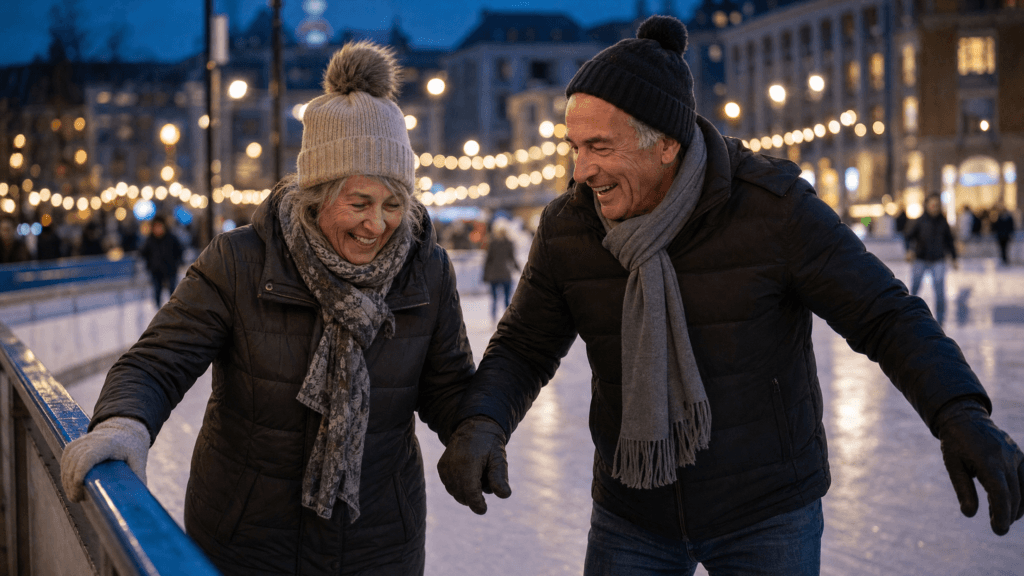
On the ice, it’s not about skill – being clumsy together bonds people faster than any conversation.
This is the idea that only exists in winter. Almost every Swiss city runs an outdoor ice rink between November and March, many of them open-air and right in the city center. Skates can be rented on site, admission costs little, and no registration is needed.
The appeal explicitly doesn’t lie in skill. No one is in control on the ice, and that’s the point. Anyone who holds onto the boards together, wobbles a little, and laughs about it skips three stages of mutual sizing-up. You casually grab each other’s arm without it turning into a grand gesture. A hot punch afterward at the edge of the rink, and the evening delivers everything a mulled wine stand promises but doesn’t follow through on.
How to make it relaxed:
- Say honestly beforehand how good you are: “I haven’t put on skates in thirty years” is a good opener, not a confession.
- Bring gloves: more important than anything else, and most people forget them.
- Staying at the edge is perfectly fine: two laps along the boards are enough for the full effect.
- For those who don’t want to go on the ice at all: watching with a cup of punch in hand works just as well – or a torchlight hike, which many mountain resorts offer in winter.
For example: the Margarethen ice rink in Basel, the Dolder ice rink in Zurich, or the Patinoire de Montchoisi in Lausanne. Many cities also have small winter ice rinks on central squares.
Mini conversation starters:
- “When was the last time you went ice skating?”
- “Is there something you could do as a child that you can’t do anymore?”
- “What would you like to learn all over again?”
Allow for 45 to 60 minutes on the ice. Longer rarely works well for unpracticed ankles, and shorter is usually just right.
If the Weather Doesn’t Cooperate
In winter, the weather itself is less of a problem than the ground conditions. Black ice, snowfall in the lowlands, and weeks of persistent fog are the three situations you should be prepared for.
- Winter hiking trail: after fresh snowfall, check beforehand whether the trail has been groomed; the mountain railways post this on their websites. Operations are suspended during storms – reschedule in that case.
- Panoramic train: runs in almost any weather – that’s why it’s on this list. In case of avalanche risk, individual sections may be closed; this is noted in the timetable.
- Hands-on museum: weather-independent, but correspondingly crowded on bad-weather weekends. It’s noticeably more pleasant on weekdays.
- Manufactory: weather-independent, provided you’ve made a reservation.
- Ice rink: open-air rinks close at short notice in rain or foehn wind. A quick check of the website the same morning is enough.
The same rule applies to all five ideas in case of black ice in the city: better to shift the time than cancel the date. By afternoon, what was still glassy in the morning has usually been cleared and salted.
Rescheduling at short notice doesn’t come across as unreliable, but as thoughtful. A brief “With this ice, I’d rather meet two hours later – does that work for you too?” is entirely sufficient.
What to bring along in winter
- Warm shoes with good tread – the most important item on this list
- A hat and gloves – anyone who’s cold stops really listening
- Sunglasses – snow glare is stronger than in midsummer
- A charged phone – batteries drain noticeably faster in the cold
- Some cash – for skate rental, punch, and small mountain inns
Safety First
The same principles apply in winter as for any first meeting: meet in a public, busy place, arrange your own travel there and back, and let someone you trust know where you are and roughly when you’ll be back. You don’t owe anyone an explanation for doing so.
Two points specific to winter should be added. It’s already dark by 5 PM, and a path that seemed harmless in the afternoon can feel isolated in the evening – plan your way back along lit, busy routes. And for anything that takes you up into the mountains: note the time of the last descent before heading up, and don’t rely on having phone reception once you’re there.
We’ve described this in more detail in our guide to safe first meetings.
Conclusion: Winter only needs one warm place within reach
A first meeting in winter doesn’t fail because of the cold. It fails because people end up sitting in a restaurant simply for lack of a better idea. Yet the season offers exactly what a first date can use: a clear structure, an early end, and a reason to warm up somewhere together.
Whether you walk along a groomed trail, ride warm and comfortable through a snowy landscape, try something hands-on together, tour a manufactory, or hold onto the boards together on the ice: what matters isn’t how unusual the idea is. What matters is that afterward, you both know whether you’d like to see each other again.
A good first date doesn’t arise from effort. A good first date arises from a framework that gives both people space.
👉 Get started with DuoLivo now – and make the most of winter for a first meeting
Frequently Asked Questions
One to an hour and a half is enough in winter – shorter than in any other season. Cold makes you tired, and a meeting that ends while both of you are still enjoying it leaves a better impression than one that drags on. Mention casually at the start how much time you have. If things are going well and you’re both warm enough, you can always extend it.
Most ideas on this list range between 15 and 60 francs per person. A visit to the ice rink with skate rental costs little, a museum admission is usually 20 to 35 francs, a manufactory tour is similar, and a train trip costs more depending on the distance. With a Half Fare Card or GA Travelcard, travel costs are significantly lower.
Write a short message, suggest an alternative, done. In winter, the more common concern isn’t rainfall but what’s underfoot – in case of black ice, it’s worth pushing the time back a few hours rather than canceling entirely. Having an indoor backup idea ready makes you look prepared rather than disorganized – and if you’d both rather postpone, that’s also a perfectly normal way to start.
For a first meeting, not really. It’s loud, cramped, and crowded, you can barely hear the other person, and you spend most of the time standing rather than moving. For people who already know each other, it makes for a lovely evening – but for a first time, it lacks exactly what a first conversation needs: calm and a bit of space.
No, and none of the five ideas require it. Winter hiking trails are groomed and walked in ordinary shoes, panoramic routes are enjoyed seated, and on the ice rink, it’s explicitly not about skill. Those who have never skied miss out on much less of the Swiss winter than is often assumed.