

Sometimes life does not change slowly, but with a sudden shift: through a separation, a divorce, the loss of a partner, children moving out, or entering retirement. Suddenly, daily life looks different than planned, and with it often the image one had of oneself. Many people in this phase speak of a restart, a new beginning, or of realigning their own lives once again.
With the change often comes a quiet, persistent thought: “Actually, I should be further along at this point.”. But it is precisely here that it is worth shifting your perspective. A new beginning after 50 is not an admission of failure. It is an expression of being honest enough with yourself not to let life continue in a way that no longer fits. In this article, we look at why the second half of life is often the more satisfying one from a research perspective, what sustains a fresh start, and what role encounters and relationships play in the process.

“Starting over at 50?” Why the thought feels so heavy
Those who suddenly face a new stage of life at 50, 55, or 60 rarely struggle only with external circumstances. It is the internal narratives that weigh heavily:
- “I should have realized this sooner.”
- “Others my age have everything figured out.”
- “Who would be interested in me now?”
- “I have lost years.”
These sentences are understandable, but they ignore something crucial: no one is guaranteed a straight path in life. And in Switzerland in particular, biographical turning points in midlife are anything but the exception.
An analysis by the Austrian Institute for Family Studies on so-called Grey Divorce shows: between 1985 and 2019, the number of grey divorce cases nearly quadrupled; in 2019, at least one person was over 50 in nearly a third of all divorces. Separations in midlife are also a reality in Switzerland: since 1970, the divorce rate has increased significantly – while one-fifth of marriages ended in divorce in 1970, this share rose to around 50% by 2010 and has since stabilized at about 40%.
If you are starting over after 50, you are not alone. Biographical turning points in the second half of life have become significantly more visible and socially normal today than they were just a few decades ago.
The U-curve of happiness – why the second half of life is often the better one
Many studies on life satisfaction show an interesting pattern: for many people, satisfaction drops in the middle years of life and rises again later. This pattern is often described as the “U-curve of happiness.”
A well-known study on this comes from economists David G. Blanchflower and Andrew Oswald, who analyzed data from around half a million people across 72 countries. The Witten-based happiness researcher Tobias Esch also describes this effect from a neurobiological perspective. He observes that many people in the later stages of life trade euphoria and stress avoidance for a calmer, more stable sense of satisfaction – a state he also calls the “satisfaction paradox.”
At first glance, this seems surprising: as we age, physical ailments, goodbyes, and limitations can take up more space. Nevertheless, many people in the second half of life report growing inner satisfaction. Statistically, subjective well-being increases again from around age 50 – paradoxically even when age-related complaints begin to appear at a certain point.
This does not mean that a new beginning automatically becomes easy. But it shows: the second half of life is not just a phase of loss. For many people, it also becomes a time of greater clarity, serenity, and inner satisfaction.

What is different and better about a new beginning after 50
A new beginning at 25 and a new beginning at 55 are two different stories. And they are not the same because something has been lost – but because something has changed.
You know better what you want. At 50+, you have experienced many relationships, career decisions, and life situations. You know your patterns. You know your boundaries. This makes decisions clearer and protects against second-rate compromises.
You have less to prove. Career, family, status: much of this has been answered. This takes the pressure out of the new beginning. What you seek now, you seek out of inner motivation, not because a life plan needs to be checked off.
You are more adaptable than you might think. Even at an older age, people remain capable of learning and change. New routines, new social contacts, and new perspectives do not only emerge in younger years – they can still grow later on.
The often-cited “clean slate” is therefore not the end of a story, but rather a new paragraph – with the same author, but clearer language.
Self-efficacy: the quiet foundation of every new beginning
If you wonder where the strength for a new beginning should come from, it is worth looking at the psychological concept of self-efficacy – the belief that one’s own actions make a difference.
A research group at the University of Zurich conducted a remarkable study on this. UZH psychology professor Birgit Kleim describes self-efficacy as a central element of resilience: the decisive factor is the belief that one can exert influence, at least in small ways, even in difficult situations – even when some circumstances cannot be changed. The study also showed a very practical effect: remembering a specific episode of one’s own self-efficacy had a significantly stronger impact than remembering a simply positive event.
This is a very practical insight. You do not have to be “strong” from day one. It is enough to remember moments when you overcame something – a move, a career change, a difficult phase with children, an illness. Such memories can help you regain access to your own resources – step by step.

Common pitfalls and how to avoid them
A new beginning after 50 has its own challenges. Three are particularly common:
Comparison with others. On social media, every relationship seems perfect, every career linear, every retirement secure. This is a distorted image. Comparing costs energy without changing anything.
Waiting for the “right moment.” Those who wait until everything is perfect – the job, the living situation, the mood, the self-confidence – never begin. New beginnings usually emerge in the doing, not before.
Trying to change everything at once. Separation, moving, new job, new sport, new circle of friends – all within a few months. This is overwhelming. New beginnings are more sustainable when one area matures after another.
A rule of thumb: do not demand of yourself the pace of someone just starting their adult life. You do not have a CV to prove, but a stage of life to shape.
The underestimated factor: relationships and encounters
Those who want to go through a new beginning alone make it unnecessarily difficult for themselves. Many findings from research on healthy aging show: social relationships, psychological well-being, activity, and the feeling of belonging play an important role in the quality of life in the second half of life.
Relationships do not necessarily mean “a new partner as quickly as possible.” It is first about encounter itself:
- Conversations in which you are perceived as a whole person again – not as “the woman who separated” or “the man who was recently widowed.”
- Activities in which you share a common interest: a walk, a concert, a hike.
- People who do not know your story in advance and see you without prejudice.
This is where reputable online dating for those over 50 intentionally steps in. A Swiss study, reported on by Netzwoche among others, concluded as early as 2019: for partnerships formed in the previous two years, 46% of couples had met online. Online dating is therefore not a last resort, but has long been a normal path – even after 50.
What helps specifically – a realistic toolbox
From research on resilience, self-efficacy, and quality of life, several points can be derived that make a new beginning after 50 easier:
- Start small. A routine that sticks is better than ten resolutions that fail. A weekly walk, a fixed appointment, a course. Self-efficacy grows with the experience of small successes.
- Allow yourself phases where things do not move “forward.” Grief, emptiness, and fatigue are part of it. They are not a step backward.
- Separate identity and role. You are more than your marriage, your job, or the role of mother or father. When a role ends, your person does not end.
- Nurture what exists and open yourself to the new. Reactivating old friendships is often the easiest step. Making new contacts is the second.
- Get support if needed. Coaching, therapy, or a consultation are not weaknesses, but tools.
How DuoLivo accompanies the new beginning after 50
DuoLivo was developed from a very specific observation: after a turning point, people over 50 often desire closeness and encounter, but not the noise and mechanisms of the large, youth-oriented apps. We therefore intentionally set different priorities:
- Clear focus on 50+. You meet people who bring similar life experiences. No mixing with completely different age groups or intentions.
- Calm instead of swiping. Profiles are meant to be read. Conversations arise from interest, not from game mechanics.
- Verified profiles. Every registration is checked before activation; additional verification steps are possible if needed. Those who are serious meet others who are serious.
- Swiss platform with clear standards. Developed in Basel, with understandable terms and conditions, a transparent membership model, clear data protection, and no subscription traps.
- Mental health considered. Less gamification, clear community rules, no pressure for constant availability.
This creates a framework in which a new beginning does not become an additional burden – but an opportunity to gradually experience connection again.
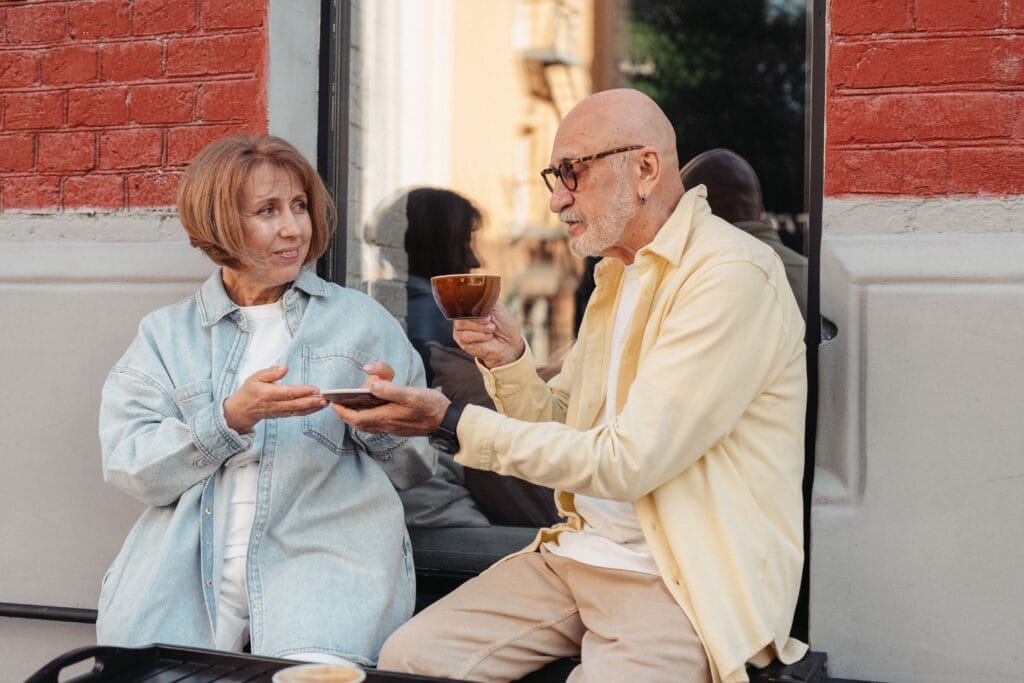
Conclusion: A new beginning after 50 is a form of courage, not of deficiency
Starting over at 50 or later is not “losing.” On the contrary:
- You are moving in a phase of life where satisfaction increases again for many.
- You possess experience, self-knowledge, and clarity that you could not have had at 25.
- You are capable of learning and forming relationships – even beyond the first half of life.
- Encounters and relationships are one of the strongest factors for well-being in the second stage of life.
A new beginning after 50 is not a repair. It is a conscious “yes” – to a life that fits you, instead of one that once fit.
If you do not wish to remain alone in this step, but want to meet people who are walking similar paths, DuoLivo is the right place for you.
👉 Discover DuoLivo now – the reputable partner search for singles over 50 in Switzerland.
FAQ – Frequently asked questions about starting over after 50
Yes, and far more common than many think. Divorces, losses, career changes, or simply the desire for more fulfillment lead many people in the second half of life to a turning point. A new beginning after 50 is not an exception – it is a widespread, well-researched phase of life.
This is very individual and cannot be broken down into months. What research shows: those who take small, concrete steps – new routines, new contacts, new interests – often experience a positive shift faster than expected. Patience with oneself is not a standstill, but part of the process.
Both at once. A new beginning after 50 rarely means leaving everything behind. Much more often, it is about re-evaluating experiences, values, and strengths from your previous life – and specifically letting go of what no longer fits. This is not a loss, but a form of maturity.
Encounters are one of the strongest factors for well-being and reorientation. DuoLivo brings together people over 50 who are familiar with similar life themes – without pressure, at their own pace. Whether new friendships, shared activities, or more: a first step on the platform can be the beginning of real support.