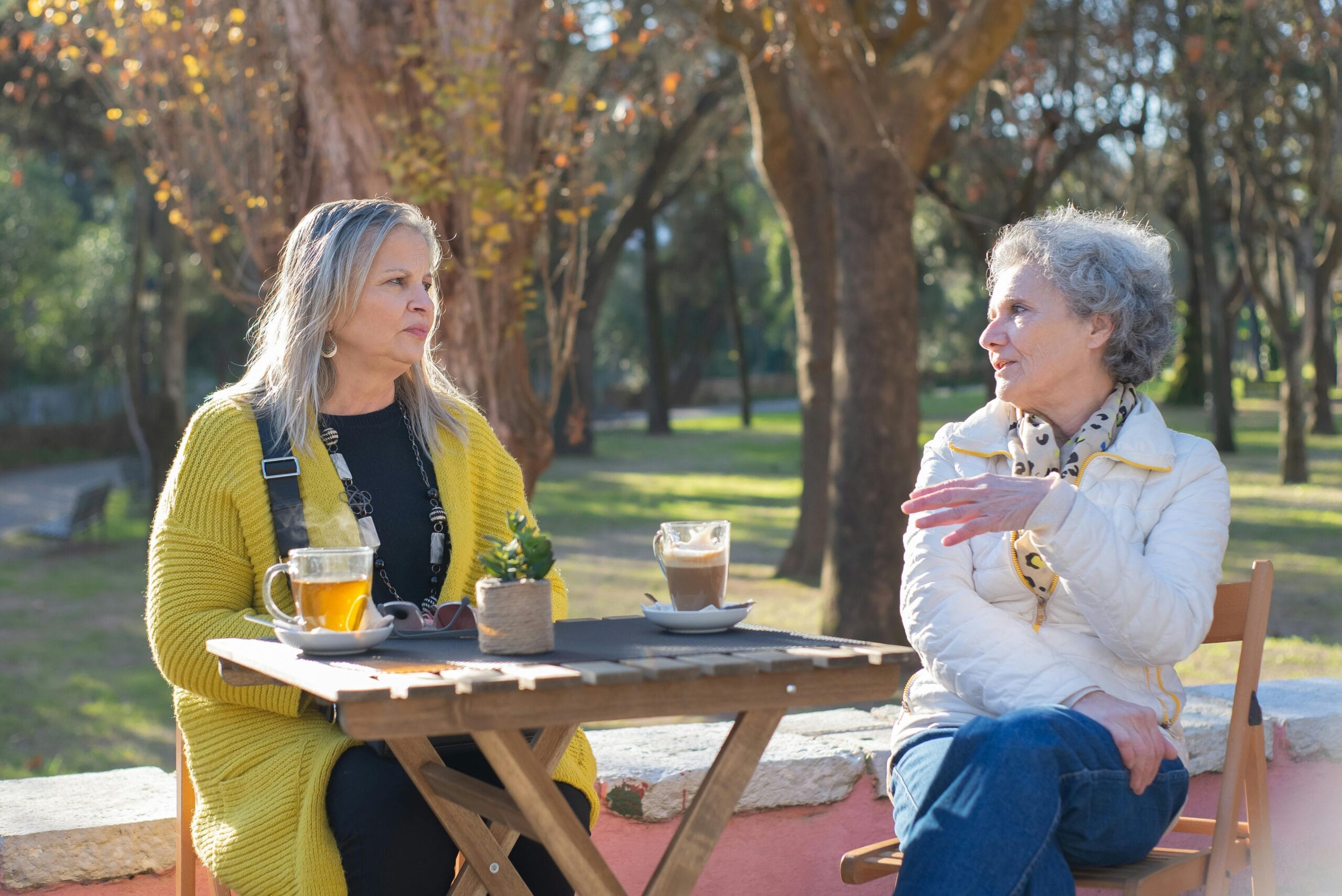

There is one topic that is rarely covered in advice guides for people over 60, even though it comes up regularly in counselling sessions: closeness. Physical closeness, tenderness, sexuality. Most of the time it is either left out entirely or addressed in a tone that feels awkwardly embarrassed.
Neither does the subject justice. In this article, we show what research actually knows about closeness later in life, what changes over the years and what that does not mean, and how to talk about it in a new relationship without it becoming uncomfortable.
Up front: this is about orientation, not prescriptions. There is no “right” amount and no standard anyone has to meet. Anyone who has decided that sexuality no longer plays a role for them has not missed out.

What research says about sexuality after 60
The foundational study on the topic comes from the United States. For a study published in 2007 in the New England Journal of Medicine, Stacy Lindau and colleagues surveyed 3,005 people aged 57 to 85. The results disproved a common assumption: sexual activity decreases with age, but more slowly than many think — 73% of 57- to 64-year-olds, 53% of 65- to 74-year-olds, and 26% of 75- to 85-year-olds had been sexually active in the previous year.
Two points from this study matter more than the percentages. First: the vast majority still considered sexuality an important part of life. Second: among those who were active, frequency declined only slightly between the fifties and the early seventies. The drop in the statistics is therefore driven less by waning interest than by people losing their partner.
As always, for context: the data are from the US and are now several years old. The core finding has since been confirmed in multiple countries.
What changes
The body changes — in both sexes. In women, hormonal changes after menopause often lead to drier mucous membranes, which can make touch uncomfortable. In men, erections become less reliable and require more direct stimulation. Both are normal, and both are usually treatable.
Two factors are also often underestimated:
- Medication. Drugs for high blood pressure, antidepressants, prostate medication and some others can affect desire and function. This can often be resolved by adjusting treatment — but only if it is addressed.
- Medical conditions. Diabetes, cardiovascular disease and pelvic surgery have an impact. This, too, is not an end point, but a topic for the consultation.
What also changes — but is rarely described as a gain — is the pace. Many things take longer and require more attention. Many people over 60 describe this not as a loss, but as an improvement.
Closeness is more than sexuality
For a substantial share of people in this phase of life, the core is not sex, but touch. A hand on the back, falling asleep next to each other, a hug that lasts longer than a greeting. Anyone who has lived alone for years often misses exactly this the most.
This is not a substitute and not a consolation prize. It is a need in its own right, and it is worth talking about it in a new relationship rather than subsuming it under sexuality.
Talking about it
The hardest part is not physical intimacy, but the conversation about it. Three things help:
Not in bed. Conversations about closeness work better while walking, in the car, doing the dishes — anywhere you are not sitting face to face and where a pause does not feel loaded.
Speak about yourself, not about the other person. “It matters to me that we take it slowly” is different from “You’re moving too fast for me”.
It is okay to be specific. Sentences such as “I need more time than I used to” or “There’s something I’m discussing with my doctor” take the pressure off. They spare the other person from interpreting it as being about them.
And the most important sentence of all, in both directions: a no does not need a justification. Not today, and not in general.

The first time in a new relationship
There is no timetable. Some couples over 60 wait months; others do not. Two things recur in almost all accounts: performance pressure and body image.
On pressure: a first time after perhaps decades with the same person, or after a long time without, does not have to prove anything. If it does not go as expected, that says nothing about the relationship. It says something about one evening.
On body image: almost everyone in this situation feels insecure about their own body — including the person opposite you who seems so relaxed. It helps to say it out loud rather than hide it.
One more practical note: intimate photos do not belong on a phone — and certainly not in a chat. They are regularly used as the basis for blackmail. We have described what to do in such a case in our article on Report, block, file a police report.
Protection is part of it
One point that is almost never addressed in this age group, and therefore belongs here: menopause ends the risk of pregnancy. It does not end the risk of infection.
In Switzerland, HIV, chlamydia, gonorrhoea, syphilis, and hepatitis B and C are notifiable. Many infections have no symptoms and can have serious consequences if left untreated. Condoms, vaccinations and a test after a risk situation significantly reduce the risk.
If you want clarity in a new relationship, you can suggest it in a matter-of-fact way: take a test together before you stop using condoms. This is not mistrust, but the same good sense you apply to other decisions. Counselling centres exist in every canton, and counselling is confidential.
When a medical check-up makes sense
If you have pain, persistent dryness, or erection problems that are new. The last point is particularly important: erectile dysfunction can be an early sign of cardiovascular problems. So it is not only a relationship issue, but also a health issue.
Clear advice: do not buy potency drugs online. Erectile enhancers have for years been the most frequently illegally imported medicines into Switzerland. In a sample of seized products, the Swissmedic laboratory found that around one third contained two to four times the active-ingredient dose approved in Switzerland. Combined with heart medication, this can become dangerous. Going through your GP practice is quicker and cheaper than most people assume.
GPs are prepared for these conversations. There is nothing you could say there that has not been discussed before.
Where you can talk about it
If you would like to exchange views with peers: Sexual Health Switzerland, together with the specialist service in Aargau, runs the pilot project “Sexuality in later life”. At its core are moderated discussion groups for people roughly between 60 and 85: one hour, five to fourteen participants, led by moderators over 60 together with a retired professional. Topics range from changes due to age, illness or the loss of a partner, to boundaries and consent, to protection against infections — and, by their own description, it is handled respectfully and without moral judgement, with confidentiality.
A practical note: the discussion groups are not booked by individuals, but by institutions, seniors’ associations, municipalities or parish communities. If you are interested, it is best to raise it with your own association.
In addition, every canton has specialist centres for sexual health that provide confidential counselling and offer tests. They are there for everyone, at any age.

Conclusion: there is no expiry date
Closeness does not stop being important. Its form, its pace and sometimes its meaning change. What mainly disappears is the pressure to have to prove something — and that is rarely a loss.
If you are at the start of a new relationship, you do not need a plan for it. It is enough to do what helps in other areas too: take it slowly, be honest, and say what you need. We describe what such a getting-to-know-you can look like step by step in our article on the second date.
👉 Discover DuoLivo now – the reputable partner search for singles over 50 in Switzerland.
Frequently Asked Questions
Yes. It changes throughout life, in both directions. Some people even experience a stronger need than before after a separation or bereavement.
You do not have to, but it makes many things easier. Unspoken expectations lead to disappointment more often than open conversations.
Yes. The risk of pregnancy ends with menopause; the risk of sexually transmitted infections does not. A test before you stop using condoms provides clarity for both of you.
Closeness is still possible. Touch, tenderness and physical familiarity are not tied to sexuality — and for many people in this phase of life, they are the more important part anyway.
With your GP, with a sexual health specialist centre in your canton, or in a moderated discussion group with peers.